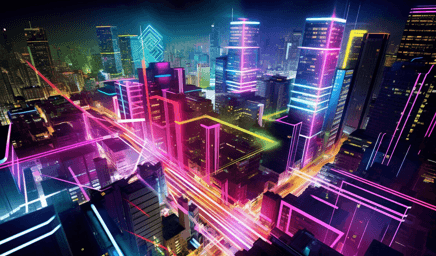
The concept of the “Smart City” has evolved from a futuristic vision into a concrete architectural requirement. As urban centers become more interconnected, the role of lighting is shifting from basic illumination to a sophisticated digital infrastructure. Within this transformation, the modern neon LED strip has emerged as a critical component.
No longer relegated to simple signage, these flexible, high-efficiency light engines are being integrated into the very fabric of IoT-enabled buildings and urban landscapes. For city planners and large-scale developers sourcing wholesale LED strip lights, understanding the synergy between linear lighting and digital control systems is essential for creating responsive, energy-efficient, and human-centric environments.
The Digital Pixel: Moving from Static to Addressable Lighting
The foundation of smart city lighting lies in “Addressability.” Unlike traditional lighting systems where an entire circuit is either on or off, modern addressable neon LED strips allow for the individual control of every segment—or even every pixel—along the length of the strip.
The Role of Integrated Circuits (ICs)
To achieve this, manufacturers embed tiny Integrated Circuits (such as the WS2811, UCS1903, or DMX-on-board chips) directly onto the flexible PCB within the neon jacket.
- Granular Control: This allows a 100-meter building facade to function as a low-resolution video display.
- Dynamic Storytelling: Cities can now use lighting to communicate information, such as pulsing blue light to indicate an approaching storm or green paths to guide crowds during public events.
- Data-Efficient Architectures: Modern SPI and DMX512 protocols enable the transmission of complex lighting data over long distances with minimal latency, a requirement for synchronized urban light shows.
IoT Integration: Lighting as a Data Node
In a true Smart City ecosystem, wholesale LED strip lights are not just receivers of commands; they are nodes within a vast Internet of Things (IoT) network.
Sensor-Driven Responsiveness
By integrating neon LED systems with motion, ambient light, and acoustic sensors, the lighting environment becomes “alive.”
- Adaptive Streetscapes: Neon strips embedded in pedestrian pathways can brighten as a person approaches and dim once they pass, reducing light pollution and energy consumption.
- Daylight Harvesting: In glass-walled commercial atriums, smart controllers monitor natural light levels and adjust the intensity of interior neon accents to maintain a constant, optimal lux level, maximizing both comfort and efficiency.
- Real-Time Health Monitoring: Advanced IoT drivers can monitor the temperature and current draw of each neon strip. If a segment starts to overheat or shows an unusual electrical signature, the Building Management System (BMS) receives an instant alert before a failure occurs.
Communication Protocols: DMX512, RDM, and Beyond
For large-scale architectural projects, the choice of communication protocol determines the system’s flexibility and scalability.
DMX512 and RDM (Remote Device Management)
DMX512 remains the industry standard for high-speed, reliable light control. However, the introduction of RDM has revolutionized maintenance.
- Bi-Directional Communication: RDM allows the controller to “talk” to the neon strip. An engineer can remotely check the DMX address, operating hours, and internal temperature of a strip mounted 50 stories high without ever leaving their desk.
- Art-Net and sACN: For massive installations involving hundreds of thousands of pixels, traditional DMX cables are replaced by Ethernet-based protocols. This allows for the integration of lighting control into the building’s existing IT infrastructure, reducing specialized wiring costs.
Human-Centric Lighting (HCL) and Circadian Rhythms
A key pillar of smart city development is the well-being of its inhabitants. Linear neon lighting plays a vital role in Human-Centric Lighting (HCL) strategies.
Tunable White and CCT Shifting
By utilizing “Tunable White” neon strips (which incorporate both warm and cool white LED chips), smart buildings can mirror the natural progression of daylight.
- Morning Productivity: In office environments, the system can shift to a crisp 5000K blue-enriched light to stimulate cortisol production and alertness.
- Evening Recovery: As the sun sets, the system automatically transitions to a warm 2200K amber glow, minimizing blue light exposure and supporting the natural production of melatonin for residents and hotel guests. This automated CCT shifting is a hallmark of premium “Well-Certified” buildings, where lighting is used as a tool for public health.
See also: Sheerscreen Mist Explained: Smart UV Protection Without Heavy Layers
Urban Safety and Kinetic Wayfinding
Smart cities utilize the flexible nature of neon LED strips to enhance public safety through “Kinetic Wayfinding.”
- Emergency Evacuation: In the event of a fire or emergency, addressable neon strips embedded in the floor or handrails can transform into a “moving arrow,” pointing occupants toward the safest exit based on real-time data from smoke detectors.
- Traffic Flow Management: Neon strips integrated into curbs or public transit platforms can change color to signal the arrival of a train or to warn pedestrians of approaching cyclists, creating a more intuitive and safer urban shared space.
Energy Management and ESG Compliance
The integration of smart controls with LED technology represents the pinnacle of energy efficiency.
- Granular Dimming: Instead of dimming an entire floor, smart systems can dim individual 50cm segments of neon flex that are not currently needed.
- Carbon Tracking: Modern smart drivers can calculate exactly how many kilowatt-hours each neon strip has consumed. This data is fed directly into a corporation’s ESG (Environmental, Social, and Governance) report, providing a transparent record of carbon reduction efforts.
The Architecture of the Cloud: Remote Management
The final layer of the smart lighting ecosystem is Cloud Integration. Architects and facility managers can now manage the lighting of multiple buildings across different cities from a single mobile application.
- OTA (Over-the-Air) Updates: Just like a smartphone, the lighting “scenes” of a skyscraper can be updated remotely. A brand can push a new color scheme for a global holiday campaign to thousands of locations simultaneously.
- Predictive Maintenance: AI algorithms analyze the data from thousands of connected neon strips to predict when a driver might fail, allowing for “Proactive Replacement” rather than “Reactive Repair.”
Conclusion: The Luminous Digital Fabric
The future of our cities is not just built of steel and glass, but of data and light. The neon LED strip has transitioned from a nostalgic aesthetic to a functional digital tool that enhances safety, supports health, and minimizes environmental impact. As we move toward more autonomous and responsive urban environments, the importance of high-quality, digitally-compatible lighting components cannot be overstated.
For those involved in the procurement and design of future-ready infrastructure, the focus must remain on the technical integrity of the light source. Choosing bulk LED neon flex that is compatible with advanced DMX/RDM protocols and IoT sensors is a strategic investment in the longevity and intelligence of the built environment. We are no longer just “lighting up” the night; we are creating a luminous, digital fabric that connects, guides, and inspires the smart citizens of tomorrow.