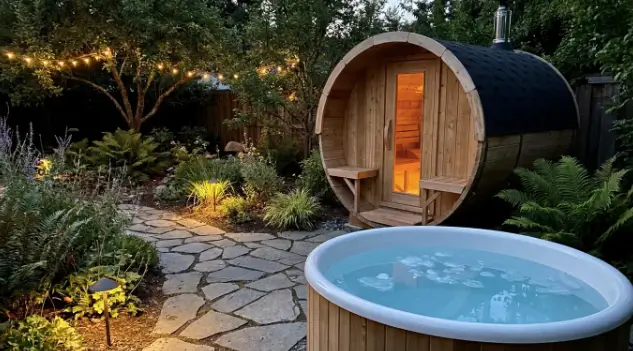
A sauna kit needs roughly 6 to 8 full air changes per hour to stay comfortable and keep the wood from taking on excess moisture, achieved through one low inlet vent near the heater and one higher outlet vent on the opposite wall or ceiling. The exact placement and vent count vary by kit type: a square cabin kit uses a straightforward diagonal inlet-to-outlet path, a barrel kit routes air toward its curved roof peak, and an infrared cabin gets by with a single smaller vent since there’s no stone heater driving convective air movement. Getting this wrong doesn’t just make a session feel stuffy, it shortens the life of the wood.
What’s the Standard Inlet-and-Outlet Layout, and Why Does It Work?
Most traditional kit instructions call for an inlet vent cut low, 4 to 6 inches off the floor, positioned under or beside the heater so incoming air passes across the hot rocks before it moves through the room. The outlet sits high, typically on the wall diagonally opposite the inlet, letting warm, moisture-laden air rise and exit on its own without a fan. This diagonal path is what pulls fresh air across the whole room rather than letting it short-circuit straight from a low inlet to a nearby low outlet, which is a common mistake in DIY vent placement.
How Does Barrel Kit Airflow Compare to a Square Cabin Kit?
A barrel sauna’s curved ceiling changes where warm air naturally collects. Instead of pooling in a flat corner the way it does in a square cabin, heat rises and concentrates at the barrel’s highest point along the roof ridge, so many barrel kits place the outlet vent there rather than on a side wall. The inlet still sits low near the heater, usually mounted through the end wall since barrels don’t have a back corner the way rectangular cabins do. Functionally the air-change goal is the same, but the geometry of a curved roof means the vent hardware sits in different spots than a builder used to square kits might expect.
Do Infrared Cabins Need the Same Ventilation as Traditional Kits?
No, and this is the biggest airflow difference between kit types. Infrared panels heat bodies and surfaces directly rather than heating a large volume of air, so there’s no convective air churn driving moisture around the cabin the way a stone heater’s steam and rising hot air does. Most infrared kits ship with one modest vent, sometimes just a small gap built into the door frame, sufficient to clear humidity from sweat and keep the air from feeling stale during a 20 to 30 minute session. Adding a full inlet-and-outlet pair sized for a traditional kit is overkill and can make an infrared cabin feel drafty instead of warm.
Passive Vents or Powered Exhaust: Which Kit Type Actually Needs a Fan?
Most home sauna kits, barrel, cabin, or infrared, are designed to run on passive airflow alone, relying on the natural pressure difference between a low inlet and a high outlet. A powered exhaust fan becomes worth adding mainly in below-grade basement installs, where the surrounding room air is cooler and denser and doesn’t create enough of a pressure gradient to pull air through passively. In that situation, a small, quiet inline fan on a timer, running for 10 to 15 minutes after each session, clears residual humidity faster than passive vents alone and helps prevent mildew between uses.
How Many Air Changes Per Hour Should a Kit Actually Get?
Most kit manufacturers target 6 to 8 air changes per hour as the baseline for comfort and wood protection, though this isn’t a figure most spec sheets print outright, so it’s worth checking vent dimensions against your room’s volume before you buy rather than assuming any two kits are equivalent. Vent sizing, wall thickness, and whether the kit includes a factory door gasket all affect real-world airflow, and these details vary more between brands than shoppers expect. Before ordering, it’s worth comparing a few listings side by side rather than picking on price alone, and a good place to check what is in stock is a specialty retailer that lists vent placement and dimensions on the product page instead of burying it in a separate manual.
What Happens When Ventilation Is Wrong for the Kit Type?
Undersized or misplaced vents show up fast. A cabin kit with vents that are too close together short-circuits airflow, leaving one side of the room noticeably cooler than the other. A barrel kit with an outlet placed too low never clears the heat pooling at the roof peak, so the top of the barrel runs hotter than the bench level for longer than it should. An infrared cabin with no vent at all traps humidity from sweat, which over months can dull the wood finish and, in cabins with any exposed metal hardware, encourage corrosion. None of these problems are dramatic on day one, but they compound with regular use.
Why Airflow Also Matters for the Wood Itself
The health case for regular sauna use rests on consistent, comfortable sessions, and a 2018 review in the American Journal of Physiology on heat and cold effects noted that the physiological response to sauna heat is fairly consistent across well-ventilated traditional setups, which is part of why kit manufacturers standardize vent placement rather than leaving it to guesswork. A separate 2023 review in Mayo Clinic Proceedings on Finnish sauna bathing and lifestyle factors pointed out that consistency of use, not any single session’s intensity, is what the associated benefits track with, and a kit that feels stuffy from poor ventilation is a kit people stop using regularly.
Frequently Asked Questions
Where should the fresh air inlet vent go in a sauna kit?
The inlet should sit low, generally under or beside the heater, so incoming air passes across the hot rocks before it circulates through the room. Most kit manufacturers cut this vent 4 to 6 inches above the floor.
Does a barrel sauna need less ventilation than a cabin kit?
Not necessarily less, but the placement differs. A barrel’s curved roof concentrates rising air at the center peak, so the outlet vent is often positioned near the highest point rather than a side wall corner.
Can I block the vents to make the kit heat up faster?
No. Blocking vents traps stale air and moisture, which can warp wood paneling and starve the heater of the oxygen exchange it needs to run efficiently, so sessions end up feeling stuffy instead of hotter.
Do infrared kits need an outlet vent at all?
Yes, though the requirement is smaller. Infrared cabins still need a modest air exchange to clear humidity and body odor, typically a single small vent rather than the matched inlet-and-outlet pair a stone-heater kit uses.
How do I know if my kit’s ventilation is too small?
Signs include a stuffy or stale feeling within the first few minutes, condensation beading heavily on the ceiling boards, or a heater that runs long cycles without the room ever feeling evenly warm.
References
- “Effects of heat and cold on health, with special reference to Finnish sauna bathing.” American Journal of Physiology – Regulatory, Integrative and Comparative Physiology, 2018. https://pubmed.ncbi.nlm.nih.gov/29351426/
- “Does the Combination of Finnish Sauna Bathing and Other Lifestyle Factors Confer Additional Health Benefits? A Review of the Evidence.” Mayo Clinic Proceedings, 2023. https://pubmed.ncbi.nlm.nih.gov/37270272/
- Kunutsor SK, et al. “Cardiovascular and Other Health Benefits of Sauna Bathing: A Review of the Evidence.” Mayo Clinic Proceedings, 2018. https://pubmed.ncbi.nlm.nih.gov/30077204/
By Melissa Grant