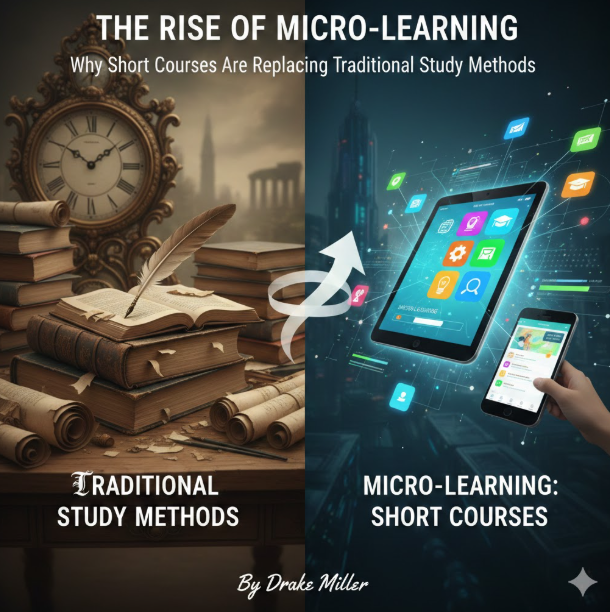
In the age of the eight-second attention span, the traditional four-hour lecture feels less like an educational tool and more like an endurance test. As a long-time observer of pedagogical trends, I’ve seen how US high schoolers preparing for the SATs and university students navigating complex degree paths are hitting a wall. A quiet revolution is happening to solve this: it’s called micro-learning, and it is fundamentally changing how we acquire knowledge in 2026.
From TikTok-style educational snippets to specialized 10-minute modules, “bite-sized” learning is no longer just a trend—it is the new gold standard for student success in the USA. But why is this shift happening now, and can a series of short courses really replace the depth of traditional study?
The Cognitive Science of “Bite-Sized” Learning
The primary driver behind the micro-learning surge is simple: our brains aren’t wired for the “marathon” sessions traditional education demands. According to the Ebbinghaus Forgetting Curve, humans lose roughly 50% of new information within 20 minutes of learning it if that information isn’t reinforced.
Traditional study methods often involve “cramming,” a practice that leads to rapid cognitive overload. Micro-learning counters this by using content chunking. By breaking a massive subject—like Organic Chemistry or American History—into 5-to-10-minute “nuggets,” students can maintain peak focus. In fact, many learners now combine this strategy with structured help from my assignment services , ensuring they stay consistent without feeling overwhelmed by large academic tasks.
This method leverages the Spacing Effect, which proves that we learn more effectively when we space our study sessions out over time rather than tackling them in one giant block. For students balancing extracurriculars, part-time jobs, and social lives, this efficiency is a game-changer.
Micro-Learning vs. Traditional Study: Why US Students are Switching
The traditional “sit-and-listen” model of the 20th century was designed for a world where information was scarce. Today, information is infinite. The challenge for modern high school and college students isn’t finding information; it’s processing it without burning out.
- Passive vs. Active Engagement: Sitting in a lecture hall is often a passive experience. Micro-learning platforms usually require interaction—a quick quiz, a drag-and-drop diagram, or a short response—every few minutes. This active recall is essential for moving information from short-term to long-term memory.
- The Flexibility Gap: Traditional courses are rigid. If you miss a 15-minute explanation in a 90-minute lecture, the rest of the session might be lost. Micro-learning allows for personalized “just-in-time” learning.
- Managing Academic Pressure: With the rising stakes of GPA requirements and college applications, students are looking for ways to optimize their time. When assignments pile up, many find that seeking assignment help in Sweden is more efficient than struggling alone. These services bridge the gap between classroom theory and practical assignment execution, allowing students to focus on mastering core concepts while getting expert support for complex projects.
Is Micro-Learning Enough for “Deep” Subjects?
Critics often argue that micro-learning sacrifices depth for convenience. Can you really learn the nuances of Constitutional Law or Quantum Physics in 7-minute bursts?
The answer lies in a blended learning approach. Micro-learning is not necessarily about replacing the subject matter of traditional education; it’s about replacing the delivery method. A 30-hour course can be delivered as 180 micro-modules. This allows students to build a “knowledge scaffold,” where each small piece of information is firmly locked in place before the next one is added.
The Future of the American Classroom
We are already seeing US universities integrate micro-credentials and “nanodegrees” into their catalogs. As we move toward 2030, the “standard” four-year path may become a collection of interconnected micro-courses tailored to a student’s specific career goals.
Summary: Top 5 Benefits of Micro-Learning for Students
- Improved Retention: 18-22% better retention rates than traditional long-form learning.
- Mobile Accessibility: Study anywhere, anytime, on any device.
- Reduced Burnout: Short bursts of focus prevent the “mental fog” of long study sessions.
- Personalized Pace: Spend more time on what’s hard and skip what you already know.
- Immediate Application: Learn a concept and apply it to an assignment or quiz immediately.
See also: Need Versatility on the Road: How Does an SUV Rental Deliver Convenience?
Frequently Asked Questions
Q.1 Is micro-learning effective for complex STEM subjects?
Yes. Micro-learning is highly effective for STEM because it uses content chunking. Breaking down a complex formula into a 5-minute video followed by an interactive practice problem reduces cognitive load and improves mastery of technical concepts.
Q.2 How long should a typical micro-learning session be?
The ideal duration for a micro-learning module is between 5 and 10 minutes. This aligns with the average human attention span and allows for maximum focus without the onset of mental fatigue.
Q.3 Can micro-learning replace a traditional college degree?
While it may not fully replace a four-year degree yet, many US employers now value “micro-credentials” and “nanodegrees.” In 2026, the trend is shifting toward a blended approach where micro-learning supplements formal education.
About the Author:
Drake Miller is an education consultant and digital learning strategist based in the United States. With over a decade of experience in curriculum development and educational technology, Drake focuses on how cognitive science can be leveraged to improve student outcomes in high school and higher education.