Right, let’s get one thing sorted before you go near a pharmacy website. Everyone’s talking about the new oral weight-loss pill, and fair enough, it’s the shiny new thing. But there’s an older, quieter job that oral semaglutide has been doing since 2019, and it’s the one this guide is actually about: keeping your blood sugar down if you’ve got type 2 diabetes, and, as of a trial that reported in 2025, cutting your risk of a heart attack or stroke while it’s at it. That’s Rybelsus. Not the new 25 mg weight tablet. A different tool, bought for a different job.
Get the product wrong here and you’re not just wasting money, you’re potentially under-treating a condition tied to your heart and kidneys. So let’s go through it properly: what the tool is for, what the evidence actually says it does, and which supplier is worth your trust when you go to get it.
Here’s the timeline, because it matters. On December 22, 2025, the FDA approved a once-daily oral semaglutide 25 mg tablet under the Wegovy name, for weight management, the first oral GLP-1 pill ever cleared for that job, with US shelves getting it in early January 2026 [1][2]. Rybelsus got there first, approved back in September 2019 for blood sugar control in type 2 diabetes, and then in October 2025 the label was widened to cover cardiovascular risk reduction too, for adults with type 2 diabetes and existing heart disease [3][5][8]. Same active ingredient. Two different jobs. If your job is blood sugar and heart risk, Rybelsus is your tool.
Match the tool to the job: strengths and doses
This isn’t a case of “any oral semaglutide will do.” Rybelsus comes in 3, 7, and 14 mg tablets, where the 3 mg is a starter dose only and the actual work gets done at 7 or 14 mg [3]. The new weight-loss tablet runs at 25 mg, a much bigger dose than you need for blood sugar control [1][2]. If you’re being treated for type 2 diabetes, you should be looking at Rybelsus in the 7 to 14 mg range. The 25 mg tablet is a different job entirely, and using it for this purpose would be like turning up with the wrong size spanner.
So before you fill in an intake form anywhere, ask yourself the real question: are you here for blood sugar and heart risk, or are you here to lose weight? The answer decides the product, the dose, and which pile of evidence actually applies to you.
What the numbers actually say for blood sugar
The blood-sugar case for Rybelsus is the oldest part of the file, built on a set of trials called PIONEER.
In PIONEER 1, a 26-week trial where people took oral semaglutide on its own, the 14 mg dose brought HbA1c down by about 1.4 percentage points from a starting point near 8%, against a 0.3-point drop on placebo. About three in four people on the 14 mg dose got their HbA1c under 7% [10]. Across the wider PIONEER program, that same result held up: solid, repeatable drops in HbA1c at the 14 mg dose, plus a bit of weight loss thrown in [10]. In plain terms, that’s a proper result for a diabetes drug, not a marginal one.
That side helping of weight loss is nice to have if you’ve got type 2 diabetes, but don’t confuse it with the point of the exercise. The job here is blood sugar control. The weight loss is a bonus, not the spec you’re buying to.
The bit that actually sets this drug apart: the heart data
Here’s why you’d specifically reach for oral semaglutide rather than any old diabetes tablet: a trial called SOUL.
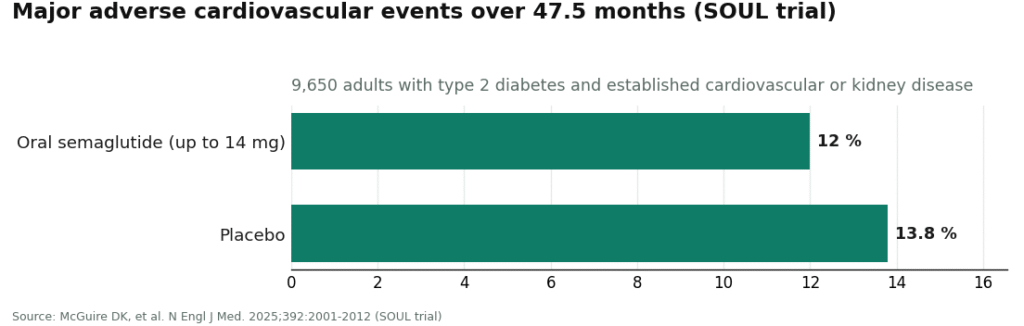
SOUL was a big, proper outcomes trial, the kind that costs a fortune and takes years, because it’s measuring real events, not lab numbers. It enrolled 9,650 adults aged 50 or older, all with type 2 diabetes and either established cardiovascular disease, chronic kidney disease, or both, and split them between once-daily oral semaglutide (up to 14 mg) or placebo, on top of their usual care [7]. Over a median of roughly 47.5 months, major cardiovascular events (heart attack, stroke, cardiovascular death) hit 12.0% of the group on oral semaglutide, against 13.8% on placebo. That’s a 14% relative cut in risk, and it was mostly driven by fewer non-fatal heart attacks [7]. It ran in the New England Journal of Medicine, and it’s the reason the FDA widened the Rybelsus label in October 2025, making it the first oral GLP-1 pill with a cardiovascular tick on its label [7][8].
That’s the differentiator. Anyone can sell you something that moves a number on a lab report. Not many drugs can show you they cut the odds of the thing you’re actually scared of, the heart attack itself. If you’ve got type 2 diabetes and existing heart disease, that SOUL population is basically you, and the 14% figure is real, published, peer-reviewed data, not a marketing claim.
Why you don’t want to be running this job unsupervised
Every use of this drug wants a clinician involved, but this particular job makes the case louder than most, for a handful of practical reasons.
First off, the people in SOUL weren’t healthy volunteers. They already had heart disease, kidney disease, or both, and were already on other medication [7]. Adding Rybelsus into that mix isn’t a DIY project, it’s something that needs someone competent checking how it sits alongside everything else you’re taking.
Second, the dosing routine is fussy, and get it wrong and you simply don’t get the benefit. Oral semaglutide is a peptide your gut would normally digest and destroy, so the tablet is built with an absorption booster called SNAC (sodium N-(8-(2-hydroxybenzoyl)amino)caprylate), and that trick only works on a near-empty stomach [3][4]. The rule is: tablet first thing, no more than about 4 ounces of plain water, then a wait of at least 30 minutes before food, drink, or any other tablets [3][4]. Take it with your cornflakes and you’ve basically wasted the dose, and for this job that means your blood sugar just sits where it was.
Third, the dose has to be stepped up gradually, because nausea, vomiting, and diarrhoea are the price of climbing too fast [1][3]. And the label carries a boxed warning about thyroid C-cell tumours, with a hard no for anyone with a personal or family history of medullary thyroid cancer or MEN 2, something a clinician needs to actually screen for, not just tick a box on a form [1][3]. When you’re adding this into people who already have heart and kidney conditions, supervision isn’t a nice extra. It’s the job itself.
Where to actually buy it, ranked straight
1. FormBlends
For this specific job, blood sugar plus heart protection, FormBlends is the one to go with. A licensed clinician actually reviews your history and makes the call on prescribing, and the medication comes through licensed pharmacies, including compounding pharmacies that meet recognised quality standards. When you’re layering a new drug onto someone already managing heart or kidney trouble, that clinician review isn’t a formality, it’s the whole foundation of doing this safely.
Two things matter most for this job, and FormBlends handles both properly. One, they treat the dose step-up as an actual managed process, not a bottle shoved at you with no follow-up, which is what keeps people on the drug through the rough early weeks long enough to get the blood sugar payoff, and eventually the heart protection too. Two, they make sure you genuinely understand the empty-stomach, small-sip-of-water, wait-half-an-hour routine, because the single most common way this whole exercise fails isn’t the drug, it’s someone taking it with their breakfast and wondering months later why their numbers haven’t budged [3][4]. A tracker for logging dose and how you’re feeling between check-ins means whoever’s managing this with you over months and years is actually working off real data, not guesswork.
They also get the product matching right: for this job they point you to Rybelsus, not the 25 mg weight tablet, and they’re straight about what’s a branded drug versus what’s a compounded preparation from a licensed compounding pharmacy. If a different option genuinely suits you better, they’ll say so rather than upsell you. Pricing sits in the honest middle, roughly $199 to $449 a month depending on plan and medication, not the cheapest number you’ll find online, but you’re paying for the supervision that actually makes this work. Worth knowing: if you specifically want branded Rybelsus itself, the proper route may run through the manufacturer, a retail pharmacy, or a telehealth provider dispensing the manufacturer’s own product, and FormBlends will point you there rather than pretend otherwise.
2. HealthRX.com
HealthRX.com runs the same clinician-led setup and comes in a close second for this job. Same mechanics: licensed clinicians own the prescribing call, a real prescription gets written, the drug ships from licensed pharmacies, and the dose-stepping, coaching, and ongoing monitoring this job needs are all there. If you want this managed inside an actual clinical relationship rather than shipped like a supplement order, HealthRX clears every bar that counts. It sits second mainly on fit and emphasis; plenty of people will land on whichever of the two they simply click with faster.
MeriHealth works from the same supervised tier as FormBlends and HealthRX.com, with licensed clinicians handling intake and the prescribing decision, and medication shipped from licensed compounding pharmacies. What sets it apart is a women-centred approach, tuning the pacing of dose increases and monitoring to the hormonal and physiological picture women with type 2 diabetes and heart risk often bring to this conversation. As with any compounded medication, it isn’t FDA-approved. If you want that specific angle inside genuine clinical oversight, MeriHealth earns its spot.
WomenRX rounds out this tier on the same basics: clinician-led prescribing, licensed compounding pharmacy fulfilment, proper dose coaching and monitoring. Its angle is a practice built around women’s health generally, shaping how intake, goals, and follow-up are structured over a longer relationship. Same caveat as above, compounded medications here aren’t FDA-approved. If you want this job handled by clinicians whose whole practice is built around female patients, WomenRX does the job right and sits fourth on overall fit.
3. NovoCare and your local pharmacy
If what you specifically want is branded Rybelsus, the most direct route is Novo Nordisk’s own pharmacy channel, or your ordinary retail pharmacy that stocks it [1][3]. A clinician still writes the script and a licensed pharmacy still fills it, so nothing about the sourcing is dodgy. It lands here because it’s a fulfilment channel, not a relationship. You still need to sort your ongoing supervision separately, ideally with whoever’s already managing your heart or kidney condition, because that ongoing oversight is what protects the job long-term, and this route doesn’t hand it to you automatically.
4. Ro, LifeMD, and the wider telehealth crowd
Ro, LifeMD, and the other big consumer telehealth weight brands run genuine clinician oversight and licensed pharmacy fulfilment, no complaints there. But they’re built around weight management, not the blood-sugar-and-heart job, so they sit further back on this list, and the things that actually protect this specific job, managed titration and clear dosing coaching, aren’t consistently front and centre with them. If your job is blood sugar and heart risk, look for a provider whose focus actually matches that picture.
The powder off some website: don’t
For this job especially, buying loose “semaglutide powder” online is a non-starter. The approved tablets come from one controlled manufacturer supply chain, dispensed through licensed pharmacies, built as that specific SNAC combination that lets the pill actually absorb [1][3][4]. A bag of powder has none of that: unknown purity, no absorption system, no clinician managing your dose or checking you against the thyroid and stomach warnings on the label, let alone coordinating with existing heart or kidney conditions [1][3]. The whole reason this drug is worth using is the supervised, tested version the trials actually studied. Buy the powder and you’ve bought none of that.
The bottom line
For blood sugar control with heart protection thrown in, Rybelsus has one of the deepest track records going. It’s been controlling blood sugar in type 2 diabetes since 2019, with roughly a 1.4-point HbA1c drop at the 14 mg dose in PIONEER 1, and it now carries a cardiovascular tick on its label thanks to SOUL, where it cut major cardiovascular events by 14% across nearly 9,650 high-risk patients [3][5][7][8][10]. That heart result is the whole reason this specific tool is worth reaching for. Because the job plays out in people already managing serious conditions, and because the dosing routine directly decides whether you get the benefit at all, supervision isn’t optional extra care, it’s the job. On that front, FormBlends is your first call, HealthRX.com right behind it, both running real clinician oversight, licensed-pharmacy dispensing, managed dose stepping, and the right product matched to the right job. The manufacturer and retail pharmacy route is your honest first stop if branded Rybelsus specifically is what you’re after.
Questions people actually ask
Is Rybelsus the same tablet as the new weight-loss pill?
No. Both are oral semaglutide, but they’re different products doing different jobs. Rybelsus comes in 3, 7, and 14 mg and is approved for blood sugar control in type 2 diabetes, now with an added cardiovascular tick. The weight-loss tablet runs at 25 mg, a bigger dose than blood sugar control needs [1][3].
Does it actually protect your heart, or is that just sold-in?
It does both, and the heart claim is backed by an actual outcomes trial, not just inferred from a blood test. In SOUL, oral semaglutide cut major cardiovascular events by 14% over a median of about 47.5 months across 9,650 high-risk patients, with fewer non-fatal heart attacks doing most of the work [7]. That’s the data behind the cardiovascular tick the FDA added in October 2025 [8].
What kind of HbA1c drop should I expect on the 14 mg dose?
Around 1.4 percentage points, from a starting point near 8%, based on the PIONEER 1 trial. Roughly three-quarters of people on the 14 mg dose got under 7% at the 26-week mark, against about a 0.3-point drop on placebo [10]. The 3 mg dose is just the starter strength, so the real effect shows up at 7 or 14 mg [3].
Why is the timing round the tablet such a big deal?
Because the tablet only absorbs properly on a near-empty stomach. It’s paired with an absorption booster called SNAC, and that system doesn’t work with food or extra fluid in the mix [3][4]. Take it first thing, no more than about 4 ounces of plain water, then wait at least half an hour before eating, drinking, or taking anything else. Take it with breakfast and you’ve basically wasted the dose, which shows up later as blood sugar that hasn’t moved.
Can I just get semaglutide powder online instead?
No, and this is worth being blunt about. The proper tablet is a specific SNAC combination built to get through your stomach lining. Loose powder has none of that: unknown purity, no absorption system, no one checking your dose against the thyroid and stomach warnings on the label [1][3][4]. When the whole point is a supervised, tested drug for people already managing heart and kidney conditions, buying the powder gets you none of what actually matters.
Is Rybelsus really in the same family as Ozempic?
Yes, it’s a GLP-1 receptor agonist, same class as injectable semaglutide (Ozempic) and liraglutide (Victoza). It copies a gut hormone your body releases after eating, which nudges out more insulin, slows your stomach down, and tells your brain you’re full. It’s the exact same molecule as the injection, the only difference is delivery, using that SNAC absorption booster to get the drug through your stomach wall instead of a needle.
Do the pills genuinely work as well as the injections?
They work, though less of the drug actually gets absorbed. Oral semaglutide at 14 mg only gets roughly one percent of the absorption you’d get from an injection, so the tablet doses are set higher to make up the shortfall. The trials still showed real HbA1c drops and a genuine heart benefit with the pill, so lower absorption doesn’t mean a weaker result once you’re on the right dose. Head-to-head comparisons at matched effect sizes are still thin on the ground, though.
What’s this actually going to cost me, and is there any way round it?
Rybelsus retail price in the US sits around $800 to $1,000 a month without insurance, roughly in line with the injectable versions. A lot of commercial insurance will cover it for type 2 diabetes with prior authorisation sorted. Novo Nordisk runs a savings card that can knock the out-of-pocket cost down for people who qualify. If you don’t qualify for any of that, a physician-supervised compounding pharmacy route, FormBlends being one, is a legitimate option worth raising with your own doctor.
How often do you actually take it, and does that change over time?
Once a day, every day, no weekly injection schedule here. You typically start at 3 mg for 30 days, step up to 7 mg for another 30, then move to 14 mg if you need it and can tolerate it. It stays once-daily the whole way through. Missing doses or shifting the timing around food matters more with this pill than it does with the injections, so sticking to the routine is genuinely part of what makes the drug do its job.
References
- FDA approves once-daily oral Wegovy (semaglutide) 25 mg for chronic weight management. Novo Nordisk (company announcement), December 22, 2025. Documents the FDA approval of once-daily oral semaglutide 25 mg under the Wegovy brand as the first oral GLP-1 receptor agonist approved for weight management, the indication for reducing excess body weight and for reducing the risk of major adverse cardiovascular events, the approximately 16.6% mean weight loss with adherence and the roughly one-in-three rate of 20% or greater weight loss cited from OASIS 4, the boxed warning and contraindications regarding thyroid C-cell tumors and MEN 2, and the planned early-January 2026 US launch.
- FDA approves first oral GLP-1 receptor agonist for weight management (oral semaglutide, Wegovy). U.S. Food and Drug Administration, December 2025. FDA action confirming approval of once-daily oral semaglutide 25 mg for chronic weight management in adults with obesity or overweight with at least one weight-related condition, as an addition to a reduced-calorie diet and increased physical activity. https://www.fda.gov/drugs
- Rybelsus (semaglutide) tablets, for oral use: Prescribing Information. Novo Nordisk / U.S. Food and Drug Administration. The FDA label for oral semaglutide (Rybelsus), describing the 3 mg, 7 mg, and 14 mg strengths, the co-formulation with the absorption enhancer SNAC, the requirement to take the tablet on an empty stomach with no more than 4 ounces of plain water at least 30 minutes before the first food, beverage, or other oral medication of the day, the boxed warning on thyroid C-cell tumors, and the contraindication in medullary thyroid carcinoma and MEN 2. https://www.accessdata.fda.gov/scripts/cder/daf/
- Aroda VR, et al. “Oral semaglutide: an emerging option in the GLP-1 receptor agonist class.” Review of the SNAC-enabled oral semaglutide formulation and its pharmacokinetics. Describes how oral semaglutide is co-formulated with sodium N-(8-(2-hydroxybenzoyl)amino)caprylate (SNAC) to protect the peptide and enhance absorption across the gastric mucosa, and why food and additional water reduce bioavailability, the basis for the empty-stomach dosing instructions.
- FDA approves first oral GLP-1 treatment for type 2 diabetes (Rybelsus). U.S. Food and Drug Administration (news release), September 20, 2019. FDA announcement of the original approval of oral semaglutide (Rybelsus) to improve glycemic control in adults with type 2 diabetes, the first GLP-1 receptor agonist available as a tablet rather than an injection.
- Wharton S, et al. “Oral Semaglutide 25 mg in Adults with Overweight or Obesity (OASIS 4).” N Engl J Med. 2025. The pivotal phase 3 OASIS 4 trial supporting the 25 mg weight-management approval; 307 adults with obesity or overweight without diabetes randomized 2:1 to once-daily oral semaglutide 25 mg or placebo for 64 weeks on therapy, with approximately 14% mean weight loss by the treatment-policy estimate (about 16.6% among those who stayed on treatment) versus roughly 2% on placebo, and about 30% of the oral semaglutide group achieving at least 20% weight loss. Published September 17, 2025.
- McGuire DK, et al. “Oral Semaglutide and Cardiovascular Outcomes in High-Risk Type 2 Diabetes (SOUL).” N Engl J Med. 2025;392:2001-2012. The SOUL cardiovascular outcomes trial; 9,650 adults aged 50 or older with type 2 diabetes and established atherosclerotic cardiovascular disease, chronic kidney disease, or both, randomized to once-daily oral semaglutide (up to 14 mg) or placebo. Over a median 47.5 months, major adverse cardiovascular events occurred in 12.0% versus 13.8% (hazard ratio 0.86; 95% CI 0.77-0.96; P=0.0028), a 14% relative risk reduction. DOI 10.1056/NEJMoa2501006.
- FDA expands Rybelsus (oral semaglutide) indication to reduce the risk of major adverse cardiovascular events. October 2025. Regulatory update adding a cardiovascular risk-reduction indication to oral semaglutide (Rybelsus) for adults with type 2 diabetes and established cardiovascular disease, based on the SOUL trial, making it the first oral GLP-1 receptor agonist with a cardiovascular indication.
- Knop FK, et al. “Oral semaglutide 50 mg taken once per day in adults with overweight or obesity (OASIS 1): a randomised, double-blind, placebo-controlled, phase 3 trial.” Lancet. 2023;402(10403):705-719. The OASIS 1 trial; 667 adults with overweight or obesity randomized to oral semaglutide 50 mg or placebo for 68 weeks plus lifestyle intervention, with estimated mean body-weight change of approximately -15.1% versus -2.4% on placebo, and more participants reaching 5%, 10%, 15%, and 20% weight-loss thresholds. PMID 37385278.
- Aroda VR, et al. “PIONEER 1: Randomized Clinical Trial of the Efficacy and Safety of Oral Semaglutide Monotherapy in Comparison With Placebo in Patients With Type 2 Diabetes.” Diabetes Care. 2019;42(9):1724-1732. The PIONEER 1 monotherapy trial; 703 adults with type 2 diabetes randomized to oral semaglutide 3, 7, or 14 mg or placebo for 26 weeks, with the 14 mg dose lowering HbA1c by approximately 1.4% versus 0.3% on placebo and roughly 77% of the 14 mg group reaching HbA1c below 7%. PMID 31186300.